Mexico City (CNN) -- Hours after Mexico's presumed president-elect, Enrique Peña Nieto, said it was time for his country to leave behind the political rancor of campaign season, his closest opponent in the polls refused to concede and said the vote had been "plagued by irregularities."
Andres Manuel Lopez Obrador, who election authorities projected as the runner-up in Sunday's presidential vote, said Monday that he was awaiting the official election results, and prepared to contest them before judicial authorities if they didn't turn out in his favor.
"The election was plagued by irregularities before, during and after the process," said Lopez Obrador.
The Democratic Revolution Party candidate's declarations echoed comments he made in 2006, when election authorities said the leftist candidate narrowly lost to Felipe Calderon. Lopez Obrador claimed election fraud and never conceded, referring to himself afterward as "the legitimate president of Mexico."
 What to expect from Peña Nieto
 A new leader for Mexico
 Officials: Peña Nieto projected winner
 <a name="em4">
 What PRI's return means for Mexico
His supporters protested nationwide. In Mexico City, they staged sit-ins and blockades.
On Monday, Lopez Obrador called on his supporters to wait for the official results. The Federal Election Institute's individual vote tally begins Wednesday.
Earlier, Peña Nieto, who election authorities projected as the winner of Sunday's presidential vote, said he was ready to work across party lines to build a better Mexico.
"We have to be constructive and put aside our differences, which are only for competitions and electoral contests," Peña Nieto told CNN en Español Monday. "Yesterday I indicated that (after) this tense and divisive atmosphere, which is natural in all democratic contests, we have to turn the page and move on to enter another chapter, another moment in our political lives, with a willingness and spirit that are constructive and purposeful."
A quick count based on samples from polling stations throughout the country gave Peña Nieto the lead, with between 37.93% and 38.55% of votes, the Federal Election Institute said late Sunday night.
The projected victory for Peña Nieto marks a triumphant return to power for the Institutional Revolutionary Party (PRI), which lost its grip on Mexico's presidency to the conservative National Action Party in 2000.
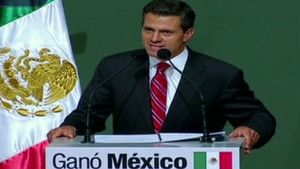
"I take with great emotion and a great sense of commitment and full responsibility the mandate Mexicans have granted me today," Peña Nieto told supporters, standing at a podium with a sign that said "Mexico won."
Peña Nieto profile
The Federal Election Institute's projections raised two key questions rooted in Mexico's complicated political past: Has the PRI, a political party that critics accuse of being authoritarian and corrupt, changed its approach? And will supporters of Lopez Obrador protest election results as they have in the past?
U.S.-Mexico relationship
Peña Nieto said Sunday night that he was looking forward, not back.
"We are a new generation. There is no return to the past. My government will have its vision based in the future," he told reporters.
On the local level, there may not be many differences between today's PRI and the political party that dominated Mexico for decades, said Andrew Selee, director of the Mexico Institute at the Woodrow Wilson International Center for Scholars.
"What's changed on the national stage is that Mexican citizens have different expectations for their federal government that are going to force the PRI to govern in a different way than it did 20 years ago," he said.
For much of the PRI's rule, the political party controlled not only the presidency, but also national and state legislatures and local governments across the country. Now, a mixture of political parties control state governments across Mexico.
In the country's Senate, a preliminary tally Monday showed the PRI winning only 33 of 128 seats. In the House of Representatives, the PRI had secured more seats than any other party, according to the preliminary tally. But opposition parties combined held a majority of seats.
"Then, the PRI was really a party that included all of Mexico, that had a broad patronage network and tolerated little dissent outside of the party," Selee said. "And the PRI today is going to have to deal with opposition parties that have tasted power, an active citizenry that expects to be involved in major policies decisions, and a very vigilant press that will report on everything that happens."
Weeks before Sunday's vote, criticisms of Peña Nieto and concerns about the PRI's possible return to power fueled a student movement that has staged demonstrations throughout the country.
But while Lopez Obrador's supporters slam Peña Nieto, the charismatic 45-year-old former governor has galvanized fervent support among residents of his home state and party loyalists nationwide.
8 things U.S. could learn from Mexico
The Consulta Mitofsky, GEA/ISA and Parametria firms said their exit poll results projected a win for Peña Nieto, with more than 40% of voters saying they cast ballots for the PRI candidate.
Peña Nieto's campaign platform included plans to stop the rise in food prices, promote energy reform, give social security to all Mexicans and reduce violence nationwide.
"He is obviously prepared. There was obviously a dirty war against him," said Martha Rojas Ramos, 58, as she prepared to cast a ballot for Peña Nieto at a Mexico City elementary school on Sunday.
Critics lamenting the possible return of the PRI to power aren't thinking straight, she said.
"That's all in the past. What's important is that he is young and has all the ability to represent us," she said.
Alejandro Garcia, a 33-year-old accountant, said he supports Peña Nieto's security strategy, which aims to decrease violence in Mexico.
Calderon, Mexico's current president, made combating cartels a top priority when he took office in December 2006. Since then, more than 47,500 people have died in drug-related violence nationwide, according to government statistics.
Garcia said the surge in violence has negatively impacted daily life throughout the country.
"People don't go out as much in the streets. People go inside their homes earlier in the day. ... Now we are seeing things that we didn't see before. Maybe they were going on, but they weren't as open as they are now," he said. "I think (Peña Nieto) is the one to stabilize the country."
นั่งอ่าน CNN อยู่เห็นข่าวนี้เลยเอามาให้เพื่อนๆดูกันครับ เป็นการเมืองในประเทศเม็กซิโก เป็นประเทศทีมีการเมืองดีในระดับนึง แต่ยังคงต้องการการพัฒนาต่อไปยิ่งขึ้น ส่วนสำคัญของเค้าก็คือการที่เสียงส่วนน้อยเคารพเสียงส่วนใหญ่ บ้านเมืองจึงเดินหน้าต่อไปได้